Network security // protocol mechanics & defense
How DNS Attacks Work: DNS Spoofing, Cache Poisoning & DNS Hijacking Explained
The Domain Name System translates human names into IP addresses over stateless UDP. When trust is misplaced, entire networks can be redirected in milliseconds. Here is how spoofing, cache poisoning, and routing hijacking operate under the hood—and how to build cryptographically resilient defenses.
Defensive Research & Educational Purpose
Zero Trust at Layer 7 Begins with Name Resolution
Every modern application security boundary—from TLS handshakes and OAuth tokens to microservice API gateways—rests on the silent presumption that an IP address resolved from a domain name points to the authentic host. When the resolution plane is compromised, perimeter firewalls and endpoint controls are bypassed without triggering alert logs. This analysis provides an architectural study of DNS vulnerability mechanics and defensive countermeasures in strict accordance with RFC standards and zero-trust engineering principles.
01 // Protocol Architecture
The DNS Resolution Chain & Its Inherent Trust Flaws
Designed in 1983 by Paul Mockapetris and codified in RFC 1034 and RFC 1035, the Domain Name System (DNS) was engineered for an academic network that presumed mutual trust between all participating nodes. To ensure maximum speed and minimal operational overhead, DNS was built primarily over the User Datagram Protocol (UDP) on port 53.
Unlike TCP, UDP is connectionless. There is no three-way handshake (SYN → SYN-ACK → ACK), no sequence number synchronization, and no native session state. A DNS packet simply consists of a source IP, destination IP, port numbers, and a 12-byte header followed by the query payload.
Client Device
An application calls getaddrinfo(). The OS stub resolver queries the configured local recursive DNS server.
ISP / Public Resolver
Checks local in-memory cache. On a cache miss, performs iterative traversal across root, TLD, and authoritative servers.
Root Hints & Registries
The 13 root server clusters direct the query to Top-Level Domain (TLD) nameservers (e.g. .com, .net, .dev).
Target Zone Server
Returns the final resource record (e.g. A, AAAA, CNAME) with a Time-To-Live (TTL) integer.
The Stateless Matching Problem: 16-Bit Transaction IDs
When a recursive resolver dispatches an iterative UDP query to an authoritative server, how does it know that the response packet arriving milliseconds later is legitimate? Historically, the protocol relied solely on matching three parameters:
- Source IP Address: Must match the queried authoritative server IP.
- Destination UDP Port: Must match the resolver's outbound UDP port.
- 16-Bit Transaction ID (TXID): A random integer in the range
0x0000to0xFFFF(65,536 possible values).
Because UDP headers do not authenticate source IP addresses, any attacker capable of spoofing raw IP packets can forge a response packet pretending to originate from the authoritative nameserver. If the attacker guesses the 16-bit Transaction ID and arrives at the recursive resolver before the authentic answer, the resolver accepts the forged answer as fact, discards the authentic packet when it arrives later, and commits the malicious record to memory.
02 // Threat Vector 1
DNS Spoofing: Local Man-in-the-Middle Injection
DNS Spoofing is the broad category of attacks where an adversary feeds fraudulent DNS resolution data to a client or server. In its most common local incarnation, DNS spoofing occurs directly on the local network segment (LAN, enterprise Wi-Fi, or public hotspot).
1. ARP Poisoning & Gateway Impersonation
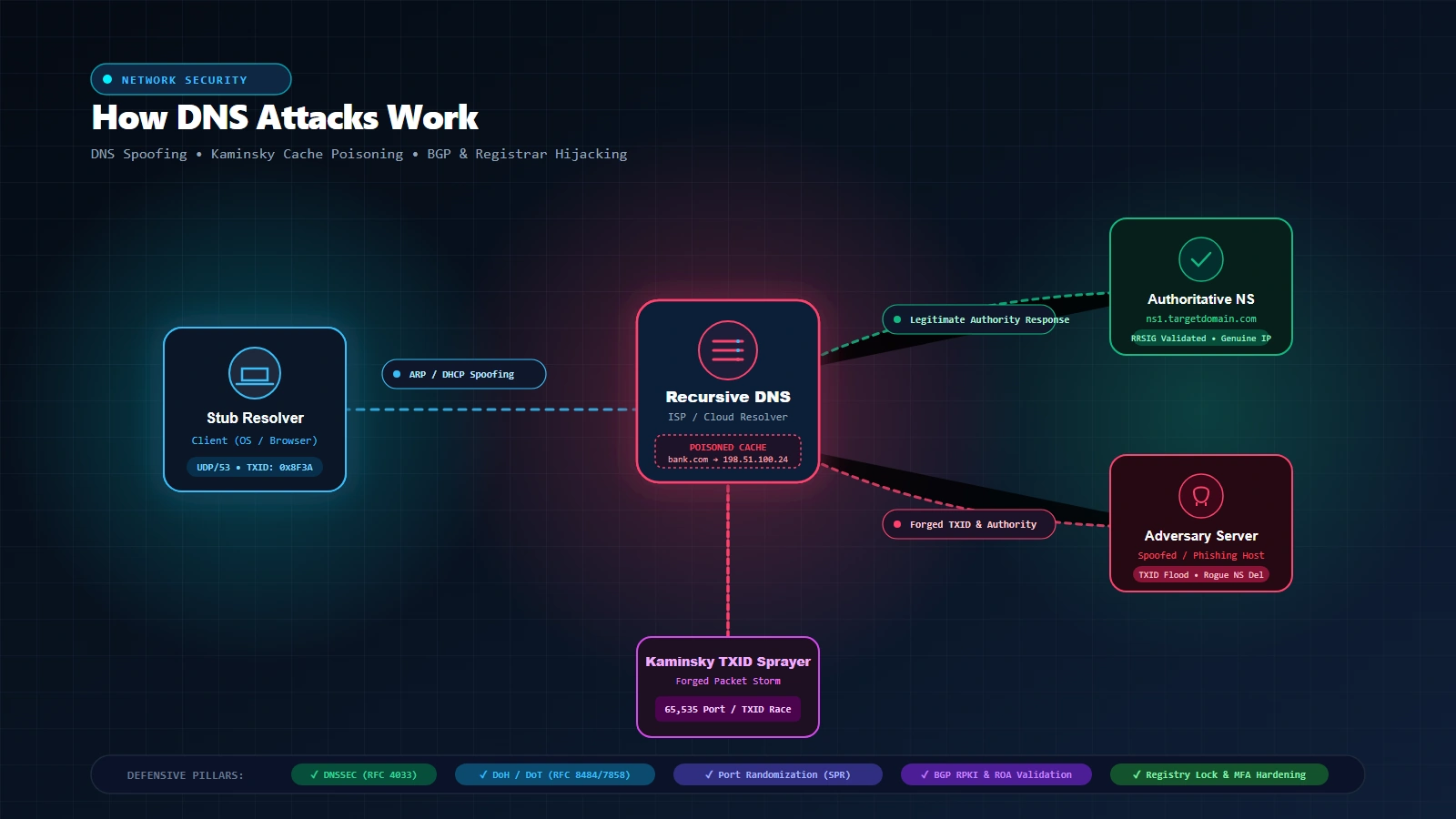
On an unsegmented Ethernet or Wi-Fi network, an attacker issues gratuitous Address Resolution Protocol (ARP) replies mapping the default gateway's IP address to the attacker's MAC address. Once established as the Man-in-the-Middle (MitM), the attacker inspects outbound UDP port 53 packets in real time. Because the attacker sees the exact query Transaction ID as it passes through their network interface, they do not need to guess anything: they emit an immediate forged DNS response containing a spoofed IP address before the real gateway can forward the packet upstream.
2. Rogue DHCP Server & Evil Twin Access Points
In public environments (airports, cafes, hotels), an attacker deploys a rogue Wi-Fi access point ("Evil Twin") with a higher signal strength or runs a rogue DHCP server that replies faster than the legitimate router. When clients connect, the rogue DHCP server assigns a DNS server IP owned and controlled by the adversary. Every subsequent domain query from that client is resolved directly to malicious infrastructure.
3. Host-Level File Tampering (The Malware Vector)
Infostealers (such as LummaC2, StealC, and RedLine) and commodity Trojans frequently modify local host resolution tables (e.g. C:\Windows\System32\drivers\etc\hosts on Windows or /etc/hosts on Linux/macOS). Because the OS checks the local hosts file before querying any network DNS server, hardcoded mappings immediately redirect security update servers, antivirus telemetry endpoints, or banking portals to localhost or command-and-control proxies.
03 // Threat Vector 2
DNS Cache Poisoning & The Kaminsky Breakthrough
While local spoofing compromises only machines on the immediate network segment, DNS Cache Poisoning targets the shared recursive resolver operated by an ISP, enterprise network, or cloud provider. If an attacker successfully poisons a central recursive resolver, hundreds of thousands of downstream users querying that domain are simultaneously redirected without any compromise occurring on their individual endpoints.
The Classical Birthday Paradox Limitation
Prior to 2008, DNS cache poisoning was heavily constrained by the domain's Time-To-Live (TTL). If an attacker wanted to poison the cache for bank.com, they sent a query for bank.com to trigger the resolver into querying upstream. The attacker then flooded the resolver with a few hundred guessed Transaction IDs.
If all guesses failed and the authentic response arrived first, the authentic bank.com record was cached with a TTL of, for example, 86,400 seconds (24 hours). The attacker could not make another attempt until the 24-hour TTL expired, making brute-force guessing statistically impractical.
01 The Classical Bottleneck
Querying bank.com caches the authentic record. When the spoofing race is lost, the attacker is locked out until the 24-hour TTL expires.
02 Dan Kaminsky's 2008 Breakthrough (CVE-2008-1440)
Instead of querying bank.com, query a non-existent subdomain: random101.bank.com. Because this subdomain is never cached, the resolver is forced to query upstream immediately on every request without waiting for TTL expiration!
03 The Authority Injection Payload
The attacker floods the resolver with forged responses for random101.bank.com. But inside the response, the attacker includes an Authority (NS) section claiming that the authoritative nameserver for the ENTIRE zone bank.com is ns.attacker.com, accompanied by an Additional (Glue) record pointing to the attacker's IP.
04 Total Zone Takeover in Seconds
By issuing thousands of randomized subdomain queries (rand1.bank.com, rand2.bank.com, ...), the attacker executes hundreds of TXID guessing races per second. As soon as one forged response wins the race, the resolver replaces the authoritative nameserver for bank.com, hijacking the entire domain indefinitely.
Dan Kaminsky's discovery triggered the largest coordinated multi-vendor security patch in Internet history in July 2008. The immediate stopgap fix was Source Port Randomization (SPR) (formalized in RFC 5452). Instead of sending every query from UDP port 53, resolvers were updated to randomize both the 16-bit Transaction ID and the 16-bit ephemeral source port (~60,000 ports). This increased the guessing entropy from \(2^{16} = 65,536\) to \(2^{16} \times 2^{16} \approx 4.29 \times 10^9\) combinations, making blind packet race attacks mathematically unfeasible over conventional network bandwidths.
04 // Threat Vector 3
DNS Hijacking: Routing & Infrastructure Seizure
Unlike DNS spoofing and cache poisoning—which exploit stateless packet transmission and timing races—DNS Hijacking seizes control of the underlying infrastructure, authoritative configuration records, or global network routing tables.
1. Consumer Router (CPE) Takeover
Malware campaigns (such as GhostDNS and Brazilian banking kits) exploit unpatched firmware vulnerabilities, TR-069 remote management ports, or default administrator credentials on home and enterprise routers. The attack overwrites the router's Primary and Secondary DNS server IP addresses with rogue resolver IPs, hijacking all traffic on the local network.
Attack Vector: Firmware & CPE Config2. Domain Registrar & Account Takeover
Attackers compromise domain registrar accounts (GoDaddy, Namecheap, Cloudflare) via credential stuffing, phishing, or SIM-swapping. Once inside, they modify the authoritative NS and A records, or initiate unauthorized Extensible Provisioning Protocol (EPP) domain transfers to offshore registrar accounts.
3. BGP Prefix Hijacking (The Route 53 Heist)
In April 2018, attackers announced rogue Border Gateway Protocol (BGP) routes for Amazon Route 53's IP prefix (205.251.192.0/21). Upstream transit providers accepted the unauthorized announcement. When users resolved myetherwallet.com, their queries were routed to the attacker's rogue DNS server, draining cryptocurrency wallets before the BGP route was withdrawn.
4. Transparent ISP Interception & NXDOMAIN Hijacking
Many ISPs and national middleboxes deploy transparent DNS proxies that intercept outbound UDP port 53 traffic regardless of what DNS IP the client configured. Some telecom operators practice NXDOMAIN Hijacking: when a user mistypes a domain, instead of returning an NXDOMAIN error, the ISP returns an advertising landing page.
Attack Vector: Transit Middlebox Interception05 // Taxonomy & Distinction
Comparative Matrix: Spoofing vs. Poisoning vs. Hijacking
Security professionals frequently conflate these three terms. The table below delineates the precise technical boundaries across attack layer, injection mechanism, blast radius, persistence, and primary countermeasure.
| Dimension | DNS Spoofing (Local) | DNS Cache Poisoning | DNS Hijacking |
|---|---|---|---|
| Classification | Local Man-in-the-Middle | Resolver State Infiltration | Infrastructure Takeover |
| Target Component | Client device, local router, or Wi-Fi segment | Recursive DNS Resolver cache (ISP / Public) | Registrar, Authoritative NS, BGP route, Router config |
| Primary Mechanism | ARP poisoning, rogue DHCP, or local packet injection | Stateless UDP packet flooding & TXID race (Kaminsky) | Credential theft, router exploit, or BGP prefix announcement |
| Blast Radius | Single device or local subnet users | All clients relying on that recursive resolver | Global (all users worldwide querying that domain) |
| Persistence | Ephemeral (active while MitM condition persists) | Cache TTL lifetime (minutes to days) | Indefinite (persists until configuration/routing is restored) |
| Detection Complexity | Medium (visible in local Wi-Fi / ARP monitoring) | High (requires resolver packet & cache auditing) | High (requires BGP telemetry & external zone monitoring) |
| Primary Defense | Encrypted DNS (DoH/DoT), Dynamic ARP Inspection | DNSSEC validation, Source Port Randomization | Registry Lock, MFA, BGP RPKI & ROA validation |
06 // Safe Interactive Model
Interactive Resolution & Attack Simulation Lab
Explore how recursive DNS resolution operates, trigger a simulated Kaminsky cache poisoning race condition, and observe how cryptographic DNSSEC verification stops rogue packets in their tracks.
Recursive DNS & Poisoning Lab
Educational browser model • Zero network requests
Stub Resolver
Client Host (OS)securebank.com
Recursive Resolver
ISP / Central CacheAuthoritative NS
ns1.securebank.com93.184.216.34
07 // Defensive Architecture
Cryptographic Hardening & Zero-Trust Mitigations
Securing name resolution requires a multi-layered defense model spanning transport encryption, cryptographic signature validation, port entropy, and routing authentication.
1. DNSSEC: Cryptographic Authenticity for DNS Records
Specified in RFC 4033, RFC 4034, and RFC 4035, Domain Name System Security Extensions (DNSSEC) adds digital signatures to DNS data. DNSSEC does not encrypt queries; instead, it guarantees two critical properties: Origin Authentication (confirming the record came from the genuine zone owner) and Data Integrity (proving the record was not altered in transit).
- RRSIG (Resource Record Signature): Digital signature attached to every Resource Record Set (RRset), generated using the zone's private key.
- DNSKEY: Public key used by resolvers to verify RRSIG signatures. A zone typically uses a Zone Signing Key (ZSK) for daily records and a Key Signing Key (KSK) to sign the ZSK.
- DS (Delegation Signer): A cryptographic hash of the child zone's KSK published in the parent zone (e.g.
.com). This creates an unbroken Chain of Trust anchored at the ICANN Root Trust Anchor. - NSEC / NSEC3: Cryptographic proof of non-existence, preventing attackers from spoofing NXDOMAIN responses.
server:
    verbosity: 1
    interface: 127.0.0.1
    port: 53

    # Enforce DNSSEC Validation
    auto-trust-anchor-file: "/var/lib/unbound/root.key"
    val-clean-additional: yes
    val-permissive-mode: no

    # Maximize Source Port & Query Randomization (RFC 5452)
    outgoing-range: 8192
    outgoing-port-permit: 1024-65535
    use-caps-for-id: yes          # DNS 0x20 bit encoding

    # Harden Cache & Guard Against Glue Record Pollution
    harden-glue: yes
    harden-dnssec-stripped: yes
    harden-below-nxdomain: yes
    harden-referral-path: yes

    # Rate Limiting against Denial-of-Service / Poisoning bursts
    ratelimit: 1000
    ip-ratelimit: 100
2. Encrypted DNS: Protecting the Last Mile (DoH, DoT, DoQ)
While DNSSEC protects against record tampering, it transmits queries in cleartext. Encrypted DNS protocols protect the transport path between the client stub resolver and the recursive resolver:
- DNS-over-HTTPS (DoH - RFC 8484): Encapsulates DNS queries in HTTP/2 or HTTP/3 over standard HTTPS (port 443), making DNS traffic indistinguishable from web traffic and defeating ISP snooping and local Wi-Fi spoofing.
- DNS-over-TLS (DoT - RFC 7858): Wraps DNS directly inside TLS over dedicated port 853, widely adopted in mobile operating systems (Android Private DNS).
- DNS-over-QUIC (DoQ - RFC 9250): Leverages QUIC on port 853 for ultra-low latency, zero head-of-line blocking, and fast connection migration.
3. Defending the Routing & Registrar Plane
- BGP RPKI (Resource Public Key Infrastructure): Route Origin Authorizations (ROAs) cryptographically link IP prefixes to authorized Autonomous System Numbers (ASNs), preventing BGP prefix hijacking against authoritative DNS infrastructure.
- Registry Lock & EPP Protection: Domain Registry Locks require out-of-band identity verification (phone authentication, multi-party approval) before nameserver records can be altered, preventing registrar account takeovers.
08 // Incident Response & Runbook
Hands-On Diagnostic & Auditing Runbook
Use these terminal inspection patterns to audit DNSSEC trust chains, inspect authoritative delegation, test DoH endpoints, and detect DNS resolution anomalies.
# 1. Trace the complete recursive resolution chain with DNSSEC validation
dig +trace +dnssec +multiline example.com

# 2. Query DNSKEY and verify the Authenticated Data (ad) flag
dig @8.8.8.8 example.com +dnssec

# 3. Cryptographically validate the DNSSEC chain using BIND's delv utility
delv @1.1.1.1 example.com

# 4. Inspect NS delegation and Glue records directly from TLD nameservers
dig @a.gtld-servers.net example.com

# 5. Query a DNS-over-HTTPS (DoH) resolver directly with curl
curl -H 'accept: application/dns-json' \
  'https://cloudflare-dns.com/dns-query?name=example.com&type=A'

# 6. Check DNS 0x20 bit capitalization support on a local resolver
dig 0x20.example.com @127.0.0.1
09 // Technical FAQ
Frequently Asked Questions
Does HTTPS make DNS security unnecessary?
No. While HTTPS displays a certificate warning if an attacker redirects web traffic to a rogue server lacking a valid certificate, DNS redirection still succeeds. Attackers exploit DNS redirection to harvest metadata, launch Denial of Service attacks, spoof unencrypted legacy protocols (SMTP, FTP, IoT telemetry), or conduct SSL stripping attacks if HTTP Strict Transport Security (HSTS) is missing.
If I use 1.1.1.1 or 8.8.8.8, am I immune to DNS attacks?
Public resolvers like Cloudflare (1.1.1.1) and Google (8.8.8.8) enforce strict DNSSEC validation, Source Port Randomization, and query rate limiting, shielding you from cache poisoning at their layer. However, if your local network is compromised (ARP spoofing / rogue DHCP), if your router's DNS settings are altered, or if you use unencrypted UDP 53 to reach those resolvers, local attacks remain fully effective. Use DoH or DoT to secure the path to the resolver.
What is the difference between DoH and DNSSEC?
DoH encrypts the communication channel between your device and the resolver (privacy & anti-eavesdropping). DNSSEC signs the actual DNS records end-to-end from the zone owner down to the resolver (authenticity & integrity). They are complementary: DoH protects the last mile, while DNSSEC protects the recursive resolution chain.
10 // Conclusion
Building an Uncompromising DNS Trust Model
DNS was built in an era when networks were small, cooperative, and insulated. Today, it remains the foundational lookup mechanism of the global internet. Defending against DNS spoofing, Kaminsky cache poisoning, and infrastructure hijacking requires moving beyond the naive assumption of stateless packet trust.
By combining DNSSEC validation at the resolver, DNS-over-HTTPS/TLS on the client, Source Port Randomization, and BGP RPKI enforcement at the network edge, organizations can transform the fragile 1980s protocol into a hardened zero-trust resolution pipeline.
Sources & Methodology
Standards, Specifications & Defensive References
- IETF RFC 1035 — Domain Names: Implementation and Specification
- IETF RFC 4033 — DNS Security Introduction and Requirements (DNSSEC)
- IETF RFC 4034 — Resource Records for the DNS Security Extensions
- IETF RFC 4035 — Protocol Modifications for the DNS Security Extensions
- IETF RFC 5452 — Measures for Making DNS More Resilient against Forgery (Source Port Randomization)
- IETF RFC 7858 — Specification for DNS over Transport Layer Security (DoT)
- IETF RFC 8484 — DNS Queries over HTTPS (DoH)
- IETF RFC 9250 — DNS over Dedicated QUIC Connections (DoQ)
- NIST Special Publication 800-81-2 — Secure Domain Name System (DNS) Deployment Guide
- CISA Emergency Directive 19-01 — Mitigate DNS Infrastructure Tampering
Editorial and Security Standards: All technical descriptions adhere strictly to IETF Request for Comments (RFC) specifications and NIST SP 800-81-2 guidelines. In compliance with Google Publisher Policies, this publication provides defensive architectural blueprints, diagnostic auditing commands, and mathematical/protocol models; no exploit code, weaponized packet generators, or active targeting tools are included.