Bangladesh fintech // one country, one QR
Tk 22.02 Crore in Just 48 Hours: The Dawn of a Cashless Bangladesh with Bangla QR
Bangladesh’s unified payment code has moved from policy to the counter. The opening numbers are impressive—but the real story is interoperability, merchant access, and whether everyday trust follows.
Data check // what the first 48 hours prove
The launch has momentum. It has not made Bangladesh cashless overnight.
Bangladesh Bank data reported by BSS and UNB shows 77,165 Bangla QR transactions worth Tk 22.02 crore on June 30 and July 1, 2026. That works out to roughly Tk 2,854 per transaction. It is a strong opening signal around the nationwide deadline, but it should not be confused with the entire digital-payments market or proof that cash has been displaced.
The more durable milestone is structural: participating banks, mobile financial services, payment service providers, and merchants are being pushed toward one interoperable standard instead of isolated QR islands.
01 // The numbers behind the headline
77,165 payments moved Tk 22.02 crore through one standard in two days.
The timing matters. Bangladesh Bank made standardized Bangla QR use mandatory from July 1, after directing providers to replace proprietary merchant QR codes by June 30. The Daily Star, citing the central bank’s Payment Systems Report 2025, reported that the network had already reached nearly 9.63 lakh merchants by the end of 2025. Forty-six banks, seven MFS providers, and four payment service providers offered the service, while more than Tk 2,700 crore moved through it during 2025.
So this was not a cold start. It was a deadline-driven unification of infrastructure already operating at scale. The same report said non-compliant providers could face penalties up to Tk 30 lakh. That turns interoperability from an optional feature into a market rule.
02 // What is Bangla QR?
One merchant code, multiple participating payment apps.
Bangla QR is Bangladesh Bank’s standardized interoperable QR payment framework, routed through the National Payment Switch Bangladesh ecosystem. Previously, a counter could become a wallpaper of provider-specific codes: one for a bank, another for an MFS wallet, and more for competing platforms. A customer with the “wrong” app might still need cash.
Merchant displays
One provider-issued Bangla QR identifies the merchant and settlement destination.
Customer scans
A supported bank, MFS, or PSP app reads the same standardized code.
Customer confirms
The payer checks merchant identity and amount, then authenticates inside the app.
Network routes
The payment moves across participating institutions and the merchant receives confirmation.
Static QR is the simplest version: the printed code identifies the merchant and the customer enters the amount. Dynamic QR can embed transaction-specific details such as the exact checkout amount and reference, making it better suited to e-commerce, billing systems, and integrated POS environments. The customer experience becomes consistent while the acquiring provider still manages onboarding, settlement, reporting, and support.
For a customer, the safe payment sequence is deliberately simple:
- Open the payment feature inside a participating financial app—never a QR scanner that only opens web links.
- Scan the merchant’s Bangla QR and verify the business name shown by the app.
- Enter or confirm the exact amount and review the funding account before authorizing.
- Authenticate inside the app, then keep the transaction reference until the merchant confirms receipt.
03 // Why it is a game-changer
A printed sticker lowers the acceptance barrier from hardware to identity.
Low-cost acceptance
A tea stall or micro-vendor can accept account-based payments without renting a card terminal.
Interoperability
Customers are less likely to abandon a digital payment because the merchant displays another provider’s code.
Better records
Digital receipts and settlement histories can support bookkeeping, dispute review, and access to formal finance.
Bangladesh Bank officials argue that traceable transactions can reduce the informal footprint, strengthen financial inclusion, improve revenue collection, and eventually lift the tax-to-GDP ratio. Digital payment also reduces some cash friction: counterfeit notes, torn currency, theft exposure, and the eternal hunt for small change.
Scale also needs perspective. The two-day figure averages about Tk 11.01 crore per day. Contemporary reporting, using Bangladesh Bank figures, placed total daily MFS transactions around Tk 5,700–5,900 crore, making Bangla QR’s opening daily volume roughly 0.2% of that much larger ecosystem. That is not a launch failure. It shows how much habitual person-to-person, cash-out, remittance, salary, and bill-payment behavior still has to be converted into interoperable merchant payment.
But inclusion is not automatic. Merchants still need an account, connectivity, onboarding support, settlement they can trust, and a clear way to resolve failed payments. Consumers need compatible apps, digital literacy, and protection from social engineering. Cash remains essential during outages and for people excluded from formal finance. A resilient cashless strategy means less dependence on cash—not pretending cash can disappear tomorrow.
Digitization also concentrates sensitive transaction data. Clear retention rules, purpose limitation, strong authentication, transparent dispute procedures, and meaningful customer consent must grow with adoption. A payment network becomes public infrastructure when citizens can trust both its uptime and its treatment of their information.
04 // Fees: read the rule carefully
Consumers should not be charged extra, but merchant MDR reporting needs clarification.
Bangladesh Bank spokesperson Arif Hossain Khan told UNB that Bangla QR purchases are free for consumers and that a merchant cannot legally pass its transaction charge to the buyer. If a shop adds a “QR fee” at checkout, ask for the official basis and report the issue to the payment provider.
MDR is normally deducted from the merchant’s settlement; it is not an extra amount the consumer should be asked to send. Rates, settlement timing, refunds, charge disputes, and promotional terms should all appear in the merchant agreement. Keep that agreement, because a spoken promise at onboarding is difficult to audit later.
05 // How to become a Bangla QR merchant
Start with a regulated acquiring provider, then complete merchant KYC.
Bangladesh Bank’s QR framework leaves merchant acquisition and risk assessment to participating institutions. That means the exact form and documents vary by provider and business type. The practical process is:
- 1
Choose an acquirer
Contact a participating bank, MFS provider, or licensed PSP that offers Bangla QR merchant acceptance. Compare MDR, settlement timing, refund support, dashboards, and service coverage—not only the sticker.
- 2
Prepare KYC documents
Expect a valid NID, recent photograph, registered mobile number, and an eligible account or merchant wallet. Formal businesses may also need a trade licence, TIN, address evidence, bank details, and incorporation or authorization documents.
- 3
Apply and verify
Use the provider’s branch, authorized merchant team, or official online channel. The acquirer verifies identity, business activity, merchant category, risk, and the settlement account before activation.
- 4
Receive and test
Display the issued static QR or integrate the approved dynamic QR/API. Make a small test transaction, confirm the merchant name shown to the payer, and verify settlement in the official merchant app or statement.
A roadside vendor may face lighter documentation than a company or e-commerce platform, but nobody should send NID images or account credentials to an unverified social-media agent. Begin from the institution’s official website, app, branch, or published support number. Ask for a copy of the fee schedule and merchant agreement before activation.
06 // Security at the counter
A unified QR removes fragmentation, not fraud.
- Verify the displayed merchant name.
Customers should stop if the app shows an unexpected person or business.
- Inspect the physical sticker.
Merchants should check for replacement labels placed over the genuine QR.
- Trust the receiving app, not a screenshot.
A customer’s edited success image is not settlement confirmation.
- Never share PIN or OTP.
Receiving a merchant payment does not require disclosing authentication secrets.
Bangla QR’s first 48 hours show appetite, not the finish line. Success will be measured by reliable rural connectivity, fast settlement, transparent charges, accessible dispute resolution, resistance to QR substitution, and whether small merchants keep using the system after promotional campaigns end.
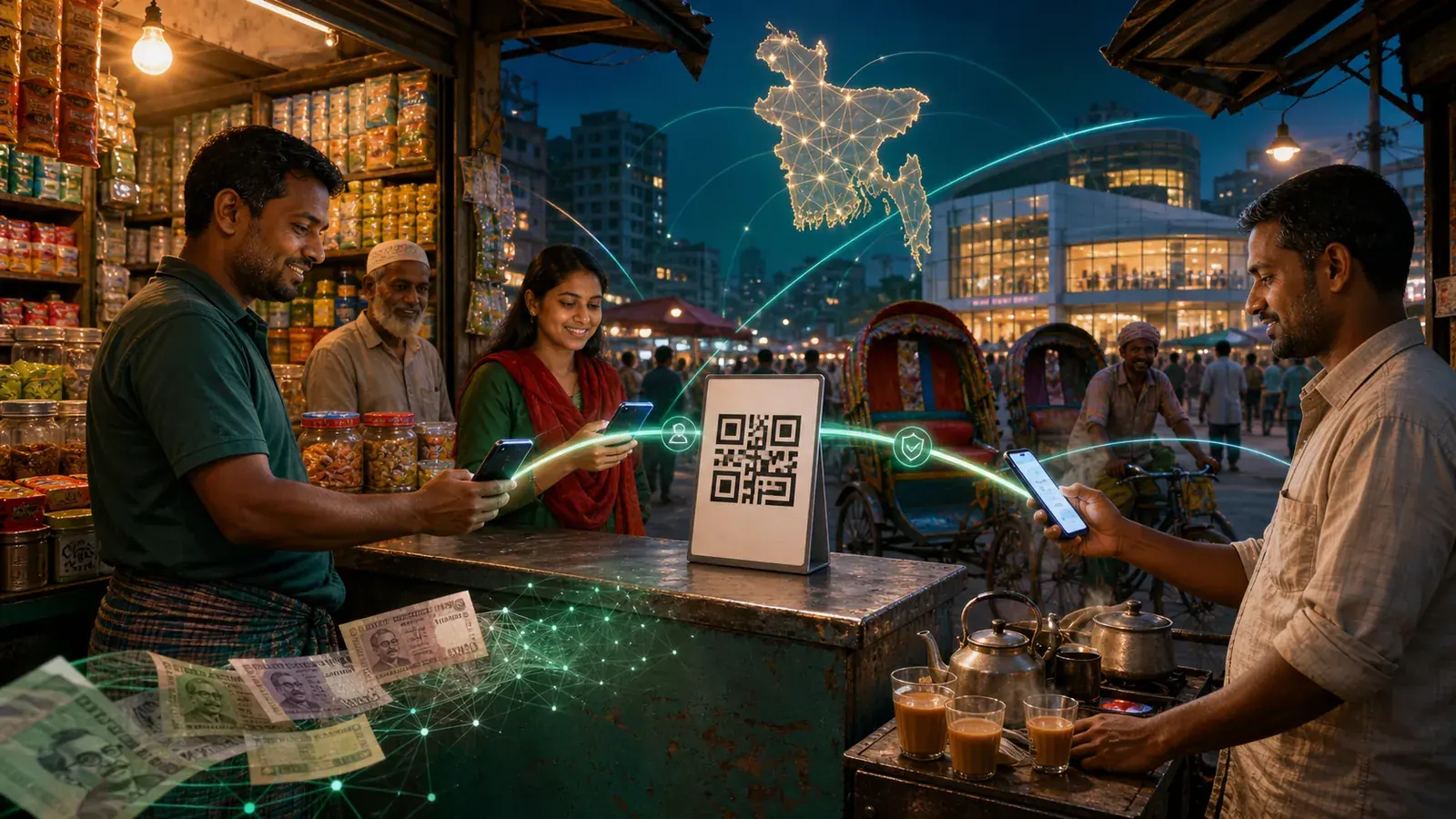
The vision is compelling: a single code at a mall, pharmacy, bus counter, tea stall, school, or government office, payable from the financial app a customer already trusts. If institutions make that experience dependable and fair, Bangla QR will do more than reduce clutter on a counter. It will become shared public infrastructure for Bangladesh’s digital economy.
Resources // official framework and current reporting
Sources and further reading
- Bangladesh Sangbad Sangstha — 77,165 transactions worth Tk 22.02 crore in two days
- Bangladesh Sangbad Sangstha — Nationwide mandatory rollout
- Bangladesh Sangbad Sangstha — Cashless campaign and economic goals
- Bangladesh Sangbad Sangstha — July 1 MDR reporting for government payments
- The Business Standard / UNB — Launch data and consumer-charge clarification
- The Daily Star — Payment Systems Report 2025 merchant and provider figures
- The Daily Star — July 1 merchant MDR interpretation
- Times of Bangladesh — Launch volume compared with daily MFS activity
- Bangladesh Bank — Bangla QR guidelines and merchant-onboarding framework
Method: Transaction totals and ecosystem figures are attributed to Bangladesh Bank data reported by BSS, UNB, and The Daily Star. The average transaction value is calculated from those totals. Onboarding requirements are a general checklist because acquirers apply their own KYC and risk rules. Fee language is deliberately qualified where published reports conflict; merchants should rely on the latest Bangladesh Bank circular and their signed provider agreement.